First, the name
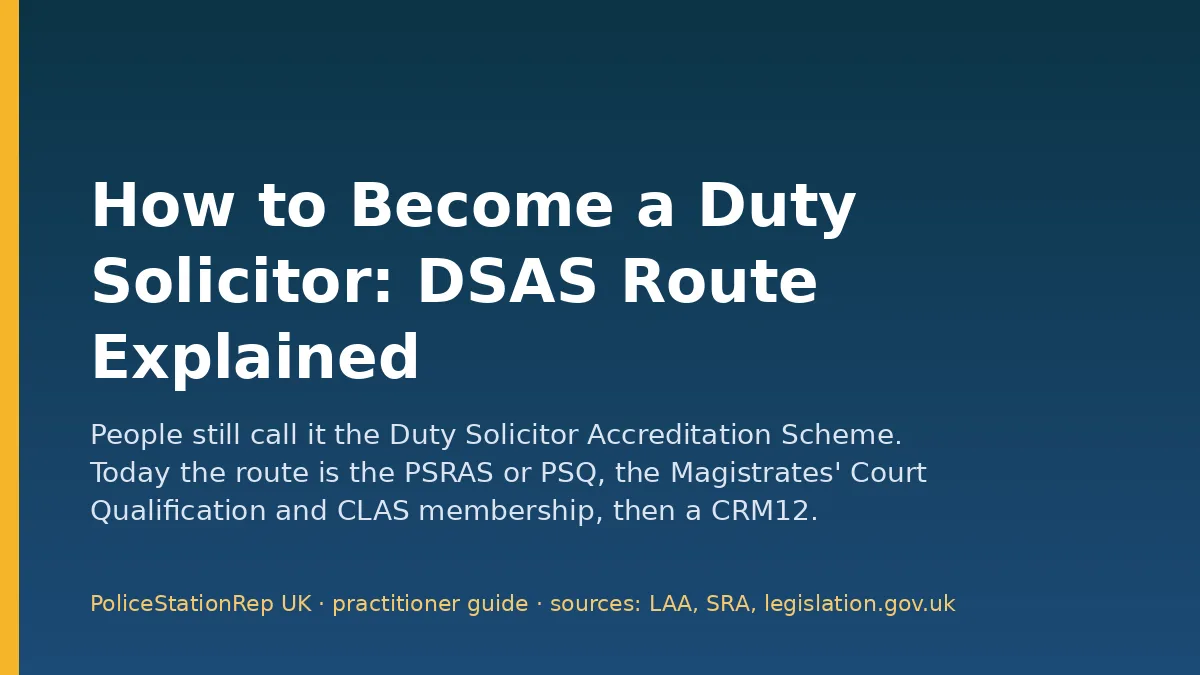
Many people search for the "Duty Solicitor Accreditation Scheme" (DSAS). That name isn't used in the current contract documents. Today, the 2025 Standard Crime Contract requires a duty solicitor to hold membership of the Criminal Litigation Accreditation Scheme (CLAS), run by the Law Society, or to have been a member of a duty scheme under a previous contract (LAA Duty Solicitor Guidance 2.1).
Duty solicitor vs police station rep vs solicitor
- A solicitor can do own-client police station work once they hold the Police Station Qualification (PSQ).
- An accredited representative has passed the PSRAS and is on the LAA register. They can do police station work for a firm, including duty work, but they aren't a duty solicitor. A probationary rep can't do duty work (Specification 9.24).
- A duty solicitor is a solicitor (or, per Cardiff University, a barrister) with CLAS membership who is on a duty scheme through a firm's CRM12, and so gets rota slots.
See duty solicitor vs rep and the accredited representative guide.
The accreditation steps
According to the Law Society's how to apply page, you pass two qualifications, in any order, then apply for accreditation:
- Police Station Qualification (PSQ). You can sit it at any time after admission to the roll. It has two assessments: the portfolio and the Critical Incidents Test, which must be completed within 12 months of each other. If you're PSRAS accredited, you don't need to complete the PSQ.
- Magistrates' Court Qualification (MCQ). You need 12 months' criminal defence practice experience before taking it. It has a portfolio and an interview and advocacy assessment.
- Apply for CLAS accreditation. Both qualifications must have been passed within three years before you apply. You submit the application form with your PSQ or PSRAS certificate and your MCQ certificate.
The SRA authorises two assessment organisations for the PSRAS: Cardiff University (Cardiff Centre for Professional Legal Studies) and Datalaw (SRA PSRAS page). Cardiff also delivers the MCQ. For courses and costs, see police station accreditation providers and fees.
Joining a duty scheme and rota
CLAS membership doesn't put you on a rota. The firm that engages you submits a CRM12 to the LAA, with a copy of your CLAS certificate if you're newly qualified, before the deadline for the next rota (LAA rota page). Your scheme depends on the location of the office you work from (Specification 6.6 and 6.7). Once you're on, you must stay Engaged: at least six police station cases a year, the court advocacy minimums, one duty attendance or slot every rolling three months, and 50 hours a month of criminal defence work for the firm (Specification 6.21 to 6.23). See duty solicitor rotas 2026.
Timescales and costs
There's no fixed national timetable. The fixed points are: 12 months' criminal defence experience before the MCQ; PSQ assessments within 12 months of each other; both qualifications within three years of applying; and the LAA's rota intakes. Cardiff's 2026 MCQ guide says there are usually two rota entry points a year, in April and October, and suggests allowing around four weeks for a CLAS application to be processed. Fees are set by the providers and the Law Society and change, so check their current price lists rather than relying on a figure in a blog.
If you're already an accredited rep
This is a common route. Once you qualify as a solicitor, your PSRAS accreditation stands in for the PSQ, so you need the MCQ and then CLAS. For training-contract routes after PSRAS, see training contract after PSRAS.
Find a supervising firm
You'll need a firm with a crime contract to engage you. Look at rep jobs and find a supervising solicitor.
Sources (primary): The Law Society, Criminal Litigation Accreditation: how to apply. SRA, Police Station Representatives Accreditation Scheme (updated 11 September 2026). LAA, Standard Crime Contract 2025: Specification section 6 and paragraph 9.24, and Duty Solicitor Guidance version 3. LAA, duty solicitor rotas page. Cardiff University, MCQ 2026 booking guide.
General information for practitioners in England and Wales, checked against the sources above on 16 October 2026. Not legal or financial advice. Contract terms and rates change: always check the current LAA documents.